Image Map
place holder
Showing posts with label Grandma's Porch. Show all posts

Aug 4, 2014

Come along and hear the song of granny's wild-grown scuppernong


O, I wish I was in the land of cotton
Old times there are not forgotten
Look away! Look away! Look away! Dixie Land.
 
The image of the south is quite fractured but the prevailing theme seems to be one of comfort, friendliness and homeliness coupled with a strong work ethic and a will to make do.  I'd say all of those things apply to my granny.  She's a born and bred southern woman who has that Midas touch.  She can make something out of nothing and figure out ways to use things that she finds around her home.  Nothing shows this more than her love for all things green and growing (besides Kudzu and poison ivy/oak).  She found some pretty little periwinkle blue ground-cover flowers in the back corner of her property and transplanted them to the front yard so she could see them while she sat on her front porch.  Instant beautification for free - just a little elbow grease required!  Another one of her transplants was her scuppernong vine. I can hear you now, scuppernong? What's a scuppernong? 

This fruit with the funny name is a staple for making jelly at granny's place and happens to be my all-time-favorite homemade jelly made by granny.

Scuppernongs are wild grapes (a type of muscadine), similar to green grapes in texture and taste but much, much plumper.  They can range in color from light green to bronze; the resulting jelly varies in color accordingly.  She found her vines growing wild many years ago and transplanted them to the side-yard next to her garden.  They are prolific producers every year and require very little effort on her part.  Beyond making sure they were trained to grow along the trellis (two posts about 8 feet apart with a sturdy wire running between them) and the occasional watering they do their own thing and reward her year-after-year with a bountiful harvest.  They are not very cold tolerant (thriving where temperatures rarely go below 10 F) so many northerners have never heard of them, but the southern folk know and they sure do make use of them.  Everything from jelly to wine is made from this lovely fruit. You can eat the fruit whole as well, there's some debate among southerners as to eating the skins but nothing says you can't and that's where most of the nutrients are. The seeds on the other-hand you'll either have to swallow or spit out. We children loved having spittin' contests with these, similar to watermelon seeds but not quite as hefty. ;-)  If granny ever made wine from them I don't recall it, I just know she makes some heavenly jelly. 

If you should be lucky enough to find yourself in the way of some scuppernongs (or scuppanons as nanny calls them) I'd encourage you to scoop them up and give granny's jelly a try.

Granny's Southern Scuppernong Jelly

Ingredients:
Several pounds (3-4) of scuppernongs (enough to yield about 5 cups of juice when done)
2 cups of water
2 tsp lemon juice (granny uses the bottled kind for convenience)
1 pack of fruit pectin (low sugar or no sugar work best)
6 1/2 cups of granulated sugar (this is not a diabetic-friendly recipe)

Tools:
large saucepan/boiler
potato masher or something similar to crush the fruit with
mason/canning jars - granny uses pint size jars
water bath canner or a large pot and canning rims to process the jars in

  1. wash and de-stem the scuppernongs
  2. place in a boiler with the 2 cups of water and bring to a rolling boil. As the fruit/water is heating crush the fruit with the potato masher to release the juices.  The more you crush the more juice will come out.  Once at a boil, reduce the heat and simmer covered for about 10 minutes.
  3. strain the mixture through a mesh sieve/strainer to remove the large solids.  You can then process through a food mill if you like but granny just strains hers through a cloth made from an old (well bleached) cotton sheet.
  4. reserve 5 cups of juice (if you don't have quite enough you can simply add some water or even white grape juice if you prefer)
  5. prepare your canner and jars.  If you don't have a water bath canner you could use a large stock pot as well, simply put some jar rims on the bottom of the pot before filling with water. You'll place your canning jars on top of the rims to keep them from sitting directly on the bottom of the pot.
  6. measure out your sugar and set aside
  7. in a large pot/boiler combine the juice, pectin and lemon juice and bring to a rolling boil - the sort you can't stir away.
  8. add the sugar in one dump and return to a full boil for 1 minute
  9. remove from heat and ladle into canning jars leaving 1/4" of headspace
  10. wipe the jar rims, add the lids and rings and process in the canner at a boil for 5 minutes (or adjust for altitude should you need to)

Voila, you've just made some scrump-diddly-iscious scuppernong jelly the southern granny way.

Granny makes hers with good ol' granulated sugar, I haven't tried it with a sugar substitute like Splenda but if you should, please let me know how it turns out.


this post may have been shared at one (or all) of these wonderful blog hops!


Strangers & Pilgrims Art of Homemaking Mondays and
Lil' Suburban Homestead's From the Farm Hop

Jul 14, 2014

How to make Granny's Old Fashioned Fig (or pear!) Preserves


A breakfast at my granny's place is just not complete without the homemade biscuits and preserves.  Not to mention the bacon, sausage eggs and whatever else she might decide to throw on the table.  As a child I didn't much care for preserves - something about the mushed up fruits just set me to crying -but I sure did love the "syrup" that came along with them.  I don't mind the fruit that much these days ;-)

Anyway, back to the preserves... since we're inching along through summer and since she always had these on hand from her very own pear and fig trees... I thought I'd share my granny's method of making her preserves.  So lets get down to it, shall we?

This is a very simple but wonderful recipe (or formula if you will):

You'll need:
  • 1 part sugar to 3 parts fruit (however much you have on hand)
  • canning jars in the size you like best - granny uses pint size ones cause that's what she has around from all her other canning, plus you just can't have too much of these yummy preserves at any given time.
  • a pot large enough to hold the fruit and sugar mixture
  • a lid for the pot
  • some lemon juice (optional) to hold the color
  • water (if needed)

Now, here's how the magic happens:

Wash & cut up the fruit, small figs get halved while larger ones get quartered.  Pears get pealed before being sliced and chunked (spellcheck tells me that's not a word but I'm going with it.)
Put those lovely figs (or pears!) into the pot with the sugar and cover with the lid.
Put them on the stove but don't turn it on.  Leave them to sit covered for 8 - 12 hours or overnight.  Then uncover and look at all that yummy fruity goodness!  Now you can add the lemon juice (or slices or squeezed halves) if you choose.
Turn the stove on and bring to a gentle rolling boil.  Simmer/boil this until the fruit has cooked down a little and become soft.  Add a little water if there isn't enough juice to keep things going while boiling.  Ladle the hot mixture into your canning jars leaving about 1/4" headspace and seal with new lids (you can reuse the rims and jars as long as you make sure to sterilize them properly. 
That's it, let them seal up on their own (you can flip them over on their heads for 15 minutes or so but don't have to) no need to waterbath can them.  You should hear them seal within 30 minutes or so, if for some reason one or two don't seal, you can put them in the fridge or freezer.  That's it!  Easy peasy right?

I hope you'll give these preserves a try - personally I love these over fresh, buttery biscuits but you could have them on toast, waffles or even pancakes or maybe even pair them with a bit of pork roast or prosciutto  if you like... experiment and see what you think.  :-)

Thanks for stopping by, I hope you'll let me know if you give them a go or even if you don't I'd love to hear your thoughts on preserves or any other little thing you might like to share.


this post has been shared at one (or all) of these wonderful blog hops!

http://trayerwilderness.com/simple-life-sunday-27/

Jul 7, 2014

How my southern granny keeps her gardening records


If you're anything like my granny, you're a record keeping junkie. She keeps notes on everything (I really mean everything) from her blood pressure readings to which medications she has taken and at what time.  Her medium of choice?  Those wall calendars with the days divided up into squares.  She used to get them from my papa's company (he was an insurance salesman back when they actually went door to door) and after that she just used whichever ones she could find for cheap at the dollar store or elsewhere.  People know she's a bit of an addict so she gets a slew of them at the start of the year from anyone and everyone (including her doctors, church friends and the postal carrier). 

One of the most prominent calendars is the one right beside the front door.  It records anything and everything to do with her garden.  My granny has had a garden for as long as I can remember.  I truly think that's what allows her to survive on an extremely limited fixed income.  It's such a part of her daily routine it's not even given much thought.  A firm believer in the early to bed, early to rise philosophy, she is up before the dawn most days and after breakfast she'll go out on the porch and check the rain gauge so see if any rain occurred overnight.  That measurement, if any, gets noted in the little box on the calendar by her door.  After that she'll go out and hoe her garden (she's a master with her hoe I tell you, I've never seen one wielded with such one-handed precision) and do any weeding (she uses her hoe to chop up and bury any weeds) or harvesting that's required.  This calendar also keeps track of what's planted and when.  If watering is needed (as indicated by the amount of rain in the rain gauge) the garden will get water in the evenings.  It seems like such an obvious sort of thing this keeping track of your gardening habits, but I would never have thought of it.  Being the girlie girl that I am, I'd have thought I needed some sort of fancy  garden log or a journal of some kind in which I record all the detailed goings on in my award winning (sarcasm here) veggie plot (that doesn't mean I don't still want one) - but nope, being the frugal southern lady that she is, granny just does the sensible thing and goes with a conveniently placed wall calendar hung by the door.  She even strings a pen up on some twine and hangs that from the same nail as the calendar.  One smart cookie if you ask me!

So how about you gardeners out there, how do you keep track of all the vital information needed for your gardens?  I'd love to hear your tips n tricks.


this post has been shared at one (or all) of these wonderful blog hops!

Jun 2, 2014

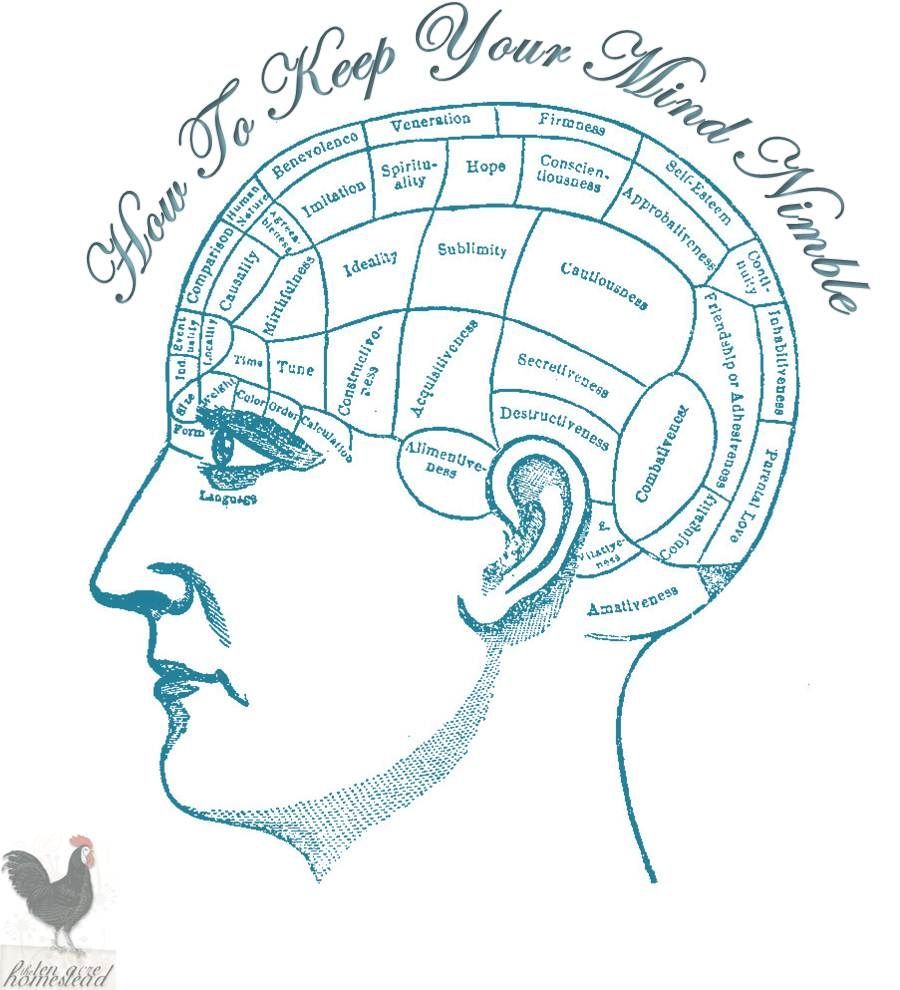
How to keep your mind nimble


In this health-conscious age the homesteading lifestyle is very attractive. What's not to like about organically grown vegetables and farm fresh, free-range eggs and chicken, right? We focus on taking in quality nutrition, getting the proper amount of exercise and trying to maintain a proper sleep cycle; but in all of this the one thing often overlooked is the mind. Alzheimer's, and other mental diseases are all too common among the elderly but there are ways to stave them off such as the previously mentioned healthy choices coupled with what my granny would call mental calisthenics.  I know a lady never tells her age, but my granny, who has passed her 8th decade and is going on her 9th, is still sharp as a tack.  Although her body has the usual age-related ailments her mind is still humming along, quick as ever.  She can run circles around most folks doing math in her head and her vocabulary is staggering.

So what's her secret?  Her mental fountain of youth?

In a word... crosswords. 

That's right, those little paperback crossword and word search booklets you can pick up in the magazine isle of any convenience store or big box store like Walmart. 

Her brands of choice are PennyPress & Dell
Being the frugal southern woman that she is, she won't pay retail prices for them either.  She does what people of her generation have always done, she takes pen and paper and writes to the publisher/company and asks them to send her their back issues.  Once every month or two she'll get a box full of them and those will keep her going for a little while.  It's a rare thing to see granny sitting still without a crossword booklet in hand.  She's even setup the side table by her recliner with a box full of pens and a stack of the booklets ready and waiting for her.


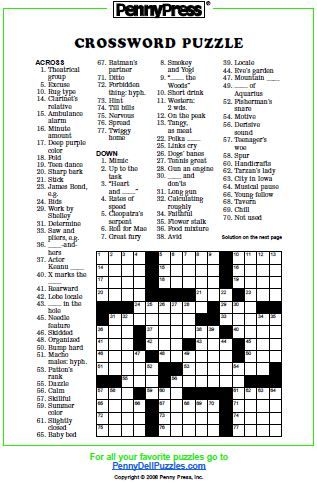
Just for fun, here is one of the PennyPress sample puzzles. Click on the image to go to their site for a printable version.
 
I hope that when I reach granny's age my mind still works half as well as hers.
 
How about you?  Do you have any mental exercises you like to do?  How do you keep your mind and body in shape?


this post has been shared at one (or all) of these wonderful blog hops!

http://trayerwilderness.com/simple-life-sunday-22/

May 5, 2014

How to shell field peas the way my southern granny does


You’re just not southern if you’ve never shelled a field pea – or at least seen your granny do it a time or two.  Shelling time, much like a quilting circle, is a time for socializing and togetherness.  Everyone gets involved.  I can see my granny sitting on her front porch now with a bucket of freshly picked peas and a bowl ready for shelling.

Field peas or Cowpeas are a southern way of life.  They grow very well in drought or dry conditions, poor soil and need very little tending.  Used as livestock fodder and historically as a subsistence food for the poor, they grace pretty much every southern table these days.  The multitude of varieties (of which the black-eyed pea is the most known) is staggering. 

My granny and grandpa live a true rural southern life.  They are my original examples of the homesteading craft and have always planted a garden, had a small orchard behind their house, canned, dried and otherwise “put up” their harvest and made do with what they had. Some variety of field peas has been a part of their garden plan for as long as I can remember.  The most memorable are the Purplehull.  These look similar to black-eyed peas when shelled, however, have a showy purple pod when ripe or dry.  They are a little smaller and creamier too.

Shelling field peas isn’t all that difficult.  These days there’s even a gizmo that will do it for you.  Granny never had that sort of thing so she’s always done it by hand.  God gave us hands for a reason, after all.

First let’s gather our supplies.

You’ll need:

·       2 large empty bowls or buckets or bags (one for the shells and one for the shelled peas) – granny uses large shallow bowls
·       1 bucket, bowl, bag or whatever of freshly picked pea pods
·       A comfortable place to sit
·       Some iced sweet tea (it’s a southern thing) and
·       A mess of friends to help

OK, now you’re all set, grab your supplies, find your seat (granny likes the old church pew on her front porch) and let’s get shellin’!

Depending on your dominant hand you’ll want to put your pea pods on your non-dominant side.

Place one empty bowl on your lap and the other beside you on your dominant side.

Take a pea pod from your bag, bucket, bowl (whatever) and snap off the top tip over the bowl beside you.  Then, using your thumbnail, split the pod down the seam (you could also use a small paring knife for this if you're very careful not to cut too deep).  Once the pod is open, make sure you are above the bowl in your lap and run your thumb down the inside.  The peas should fall right into your bowl.  That’s all there is to it!

Shelled peas can be cooked immediately, frozen or cooked and canned.  At any rate you’ll need to process them quickly as they don’t last long after being taken from the vine.  Granny likes to freeze hers.  She will also let some pods dry on the vine to store as dry peas and to use as seeds for the next year.

One little note of caution:  make sure you wear something that you don’t mind getting stained.  If you’re shelling a colored variety like the Purplehull your fingers WILL be purple and you may transfer some of that to your clothing along the way.

Happy shellin’ y’all!

I'll share Granny's field peas & skillet cornbread recipe in a separate post.

Have you ever had field peas? If so what kind?
 
This post has been shared on the following "Hops": Homestead Barn Hop; Backyard Farming Connection; HomeAcre Hop